Your Kitchen, Their Kitchen, Our Kitchen: Navigating Gluten-Free Cohabitation

By Mallorie Williams, GIG Outreach
Being gluten-free comes with a lot of mental math and overanalyzing to confirm that what you are about to eat is completely safe. Now imagine how much harder it is in a shared kitchen. In this article, we will discuss how some simple precautions and communicating with your household can lighten this load immensely.
Small Traces, Big Consequences
Most of us know the importance of cross contact, but how can we put it into simple terms for a non-gluten-free individual to understand without overwhelming them?
The easiest way to explain cross contact is to think about perfume or cologne. If someone wearing a strong fragrance walks through a room and leaves, the scent lingers long after they are gone, even though you cannot see it. Gluten works the same way. It does not need to be visible to cause a reaction. A knife used to spread regular peanut butter, a shared cutting board, or a colander that once drained wheat pasta can all leave behind enough traces to make someone with celiac disease seriously ill.
For younger members of the household, the glitter explanation works just as well. Ask them to think about doing a glitter craft project. Even after washing their hands, glitter somehow ends up on the table, the chair, their shirt, and maybe even the dog. Gluten behaves just like glitter. Once it enters a shared space, it spreads to surfaces, utensils, and foods in ways that are invisible but very real. And just like glitter, it is almost impossible to fully get rid of once it is there.
Understanding cross-contact is the first step. The next is knowing how to set up your shared kitchen so that everyone can cook and eat with confidence.
Divide and Conquer: Organizing a Safe Shared Space
Designating specific utensils, areas, and appliances for gluten-free use can go a long way in limiting risk and giving you peace of mind at mealtimes. A simple and effective way to do this is color coding. Assign a specific color to everything that is strictly gluten-free: cutting boards, mixing bowls, storage containers, tongs, and spatulas. Make sure everyone in the household knows what that color means. It takes the guesswork out of grabbing the wrong tool in a busy kitchen and creates a visual system that is easy for the whole household to follow.
When it comes to appliances, the conversation gets a little more nuanced. Some appliances can be shared if they are thoroughly cleaned before gluten-free use, but others should be designated gluten-free only. Toasters, air fryers, and blenders are at the top of that list. These appliances have grooves, vents, and hard-to-reach areas that trap crumbs and residue, making it nearly impossible to guarantee they are fully free of gluten no matter how well you clean them. If a separate appliance is not an option right away, consider a toaster bag as a temporary solution, and be especially cautious with anything that has a blade or a basket.
Just as you would designate specific appliances and utensils, it is equally important to label your gluten-free foods and assign dedicated areas of the fridge and pantry for them. If you do share a condiment or similar item, make sure your housemates understand why double dipping is not an option. Keep everything properly sealed and store your gluten-free products on higher shelves in the pantry or fridge to prevent gluten crumbs from falling into them.
It is also important to remember that designated zones and color-coded tools are a great foundation, but they are not a guarantee on their own. Cross-contact can still happen, which is why sanitizing surfaces and utensils before every meal preparation is a habit worth building, not just an occasional precaution.
Speaking of cleaning, knowing the difference between a quick wipe-down and a truly safe cleaning process is where a lot of households get tripped up. Let’s talk about what proper cleaning actually looks like in a shared kitchen.
Sometimes Clean Enough Is Not Always Enough
It is not feasible for every household to own two sets of pots and pans or a second oven, so knowing how to properly clean shared cookware and surfaces is essential. First and foremost, it is important to remember that simply wiping a surface or rinsing an appliance with water is not clean enough and is not safe. Gluten is a protein, and unlike bacteria, it is not destroyed by heat or killed by most standard cleaning sprays. It must be physically removed.
This distinction matters more than most people realize. Rinsing removes visible debris but leaves behind proteins, residue, and invisible traces of gluten. Washing with hot soapy water goes further by breaking down and lifting residue from the surface. Sanitizing is the final step and is what actually reduces the risk to a safe level. A food-safe sanitizer, a diluted bleach solution, or a sanitizing spray applied after washing is what completes the process. All three steps together, rinse, wash, sanitize, are what make a surface or item truly safe for gluten-free use. Skipping any one of them leaves room for cross contact.
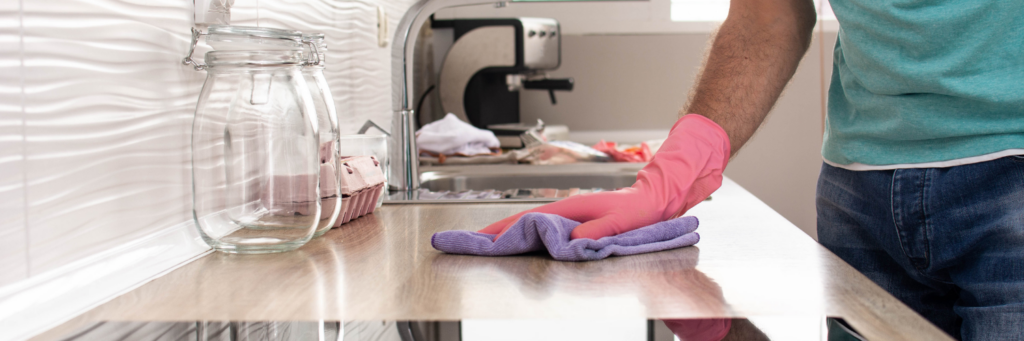
Kitchen counters, tables, and prep areas should be washed with hot soapy water and a clean cloth or paper towel before any gluten-free meal preparation begins. After washing, follow up with a food-safe sanitizing spray to ensure the surface is truly clean. Pay special attention to areas around the toaster, bread box, or anywhere wheat-based foods are regularly prepared.
Most standard dish soaps are effective at removing gluten when used with hot water and proper scrubbing. There are a few things to keep in mind though. Shared sponges and dish rags should be replaced or laundered frequently, as they can transfer gluten from one surface to another. Dish soap dispensers and cleaning tool handles are also easy-to-miss contact points that should be wiped down regularly. For an extra layer of protection, keeping a dedicated gluten-free dish sponge or brush is a small investment that makes a big difference.
Pots and pans can generally be shared safely if they are washed thoroughly with hot soapy water after every use. However, there are some exceptions worth noting. Scratched or worn non-stick pans can trap gluten in the damaged coating and are much harder to clean thoroughly, so if your non-stick cookware is showing signs of wear, it may be time to designate a separate gluten-free pan. Cast iron is another exception, as it is porous and nearly impossible to fully rid of gluten residue. If cast iron is regularly used in your household for gluten-containing foods, a dedicated gluten-free cast iron pan is strongly recommended.
The oven is often overlooked but is one of the most important appliances to address in a shared kitchen. Crumbs, drips, and splatters from gluten-containing foods can build up on oven racks and the oven floor over time, and the high heat of baking does not neutralize gluten. Before preparing a gluten-free dish in a shared oven, wipe down the oven racks and interior, use a fresh sheet of foil on the rack, or place your dish on a clean baking sheet that acts as a barrier between the food and the oven’s surface. Regularly cleaning the oven as part of your household routine also helps keep the risk low for everyone.
Same Kitchen, Same Team
The most important thing to take away from all of this is that while you have higher needs than your housemates, it is still the same kitchen and the same team. Sit down together and have a genuine conversation about how to make shared space work for everyone. Explain cross-contact, walk them through what proper cleaning looks like for your safety, and share why all of it matters. From there, come up with dedicated roles for each person so that the burden and mental load of maintaining a safe kitchen does not fall on one set of shoulders. A little communication and a shared commitment go a long way toward making a gluten-free life in a shared kitchen not just manageable, but truly livable.